
Coronary Angiogram in Dwarka
Dr. Amit Pendharkar Senior Director & Unit Head – Interventional Cardiology
A coronary angiogram is an X-ray test that shows whether the arteries supplying the heart are narrowed or blocked. Dr. Amit Pendharkar performs coronary angiography at Max Super Speciality Hospital, Dwarka, for patients from Dwarka, Janakpuri and other parts of West Delhi.
With more than 10,000 diagnostic and interventional cardiac procedures and a DM in Cardiology from AIIMS, New Delhi, Dr. Pendharkar provides comprehensive evaluation of coronary artery disease and guides patients on the appropriate treatment based on their angiogram findings.
What Is a Coronary Angiogram?
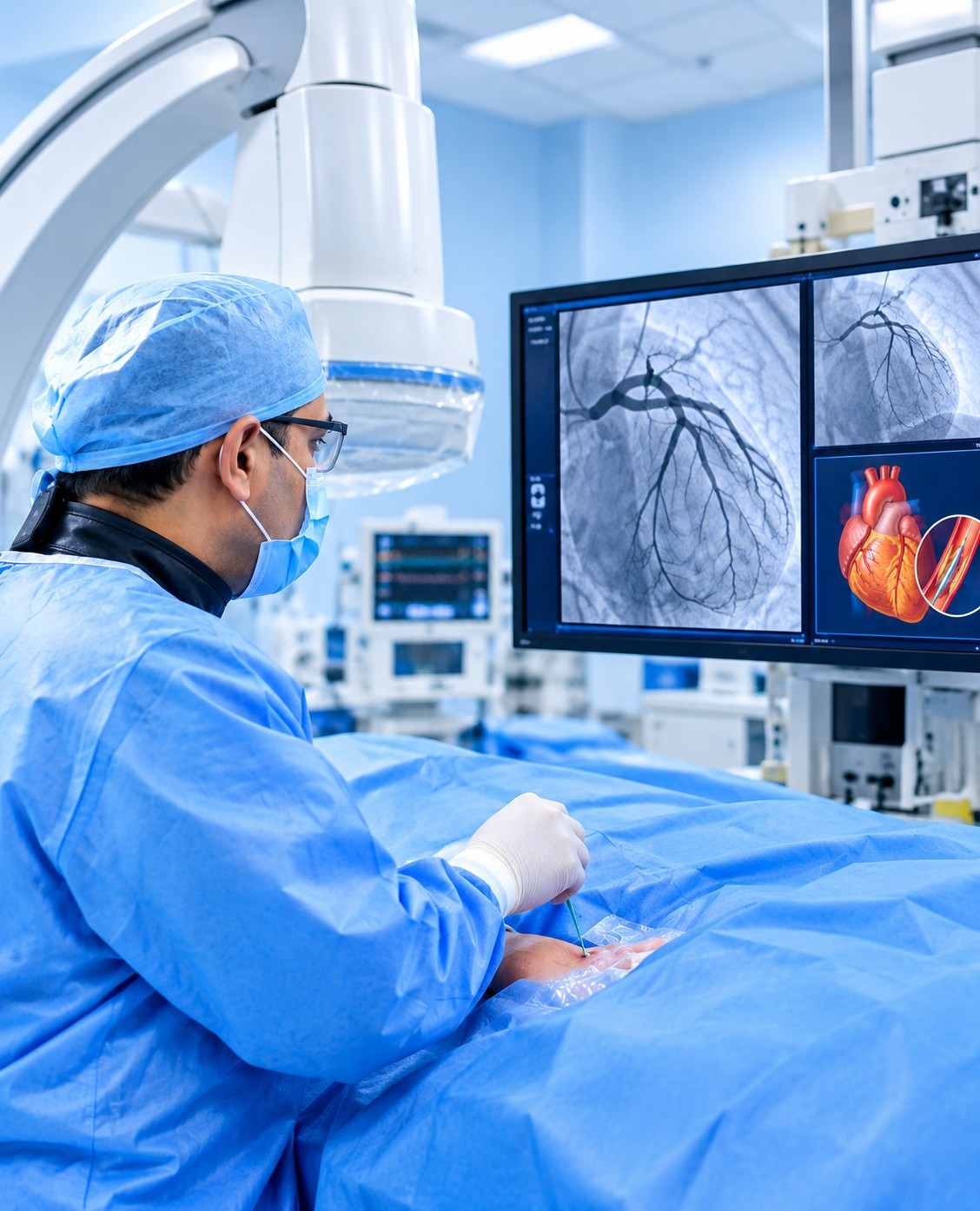
In a coronary angiogram, a thin flexible tube called a catheter is passed through an artery in the wrist or groin and guided to the heart. A contrast dye is then injected, and X-ray pictures show the arteries filling with dye. Narrowed or blocked sections appear as gaps or tapering in the picture.
- Helps identify narrowed or blocked coronary arteries
- Catheter access through the wrist or groin artery
- Contrast dye and X-ray imaging are used to view the arteries
- Performed under local anaesthetic while the patient remains awake
Why a Coronary Angiogram Is Done
A cardiologist may advise the test in these situations:
Chest pain or tightness that suggests angina
Breathlessness that has no clear cause
An abnormal treadmill test, echocardiogram or CT scan
A heart attack, or a suspected one
Planning for heart valve surgery or bypass surgery
Heart failure where a blocked artery may be the cause
Coronary Angiogram vs Angioplasty
The two are often confused. Angiography finds the problem. Angioplasty treats it.
| Parameter | Coronary angiogram | Coronary angioplasty |
|---|---|---|
| Purpose | Diagnosis: shows where and how severe a blockage is | Treatment: opens the blocked artery |
| What is done | Dye is injected and X-ray pictures are taken | A balloon widens the artery and a stent is usually placed |
| Typical duration | About 20 to 30 minutes | 30 to 90 minutes, longer in complex cases |
| Hospital stay | Often same day | Usually one to two days |
| Is it always followed by the other? | No. Many angiograms show no need for a procedure | Only if the angiogram shows a suitable blockage |
Understanding the Results
| Finding | What it usually means | Likely next step |
|---|---|---|
| Normal arteries | No significant blockage | Look for other causes of symptoms; risk-factor control |
| Mild narrowing | Early coronary artery disease | Medicines, lifestyle changes and regular follow-up |
| Significant single blockage | A major artery is narrowed | Angioplasty with stent, often in the same sitting if suitable |
| Multiple or complex blockages | Several arteries or a difficult location involved | Complex PCI or a discussion about bypass surgery |
Every case is different. The treatment plan depends on the pictures, your symptoms and your overall health.
Why Consult Dr. Amit Pendharkar for a Coronary Angiogram in Dwarka
-
DM in Cardiology from AIIMS, New Delhi, with more than 15 years of experience
-
More than 10,000 diagnostic and interventional procedures, and more than 10,000 echocardiograms and stress tests
-
Leads interventional cardiology at Max Super Speciality Hospital, Dwarka
-
Can proceed to angioplasty in the same sitting when it is needed and appropriate
-
Clinics in Dwarka Sector 6 and Janakpuri for consultation and follow-up
The Procedure Step by Step
You change into a hospital gown and an IV line is placed in your arm.
The skin at the wrist or groin is cleaned and numbed with local anaesthetic.
A catheter is passed through the artery to the heart under X-ray guidance.
Dye is injected and pictures of the coronary arteries are recorded.
The catheter is removed and pressure or a small band is applied to the puncture site.
How to Prepare for a Coronary Angiogram
- Fast for the period the hospital advises, usually several hours before the test.
- Tell the doctor about all medicines, especially blood thinners and diabetes medicines.
- Mention any allergy to contrast dye, iodine or shellfish, and any kidney problem.
- Bring earlier ECG, echocardiogram and blood test reports.
- Arrange for someone to accompany you and take you home.
Recovery After the Test
You rest for a few hours while the puncture site is checked. Drinking plenty of fluids helps the body clear the dye. Most people resume light activity the next day. Avoid heavy lifting with the treated arm or leg for a few days, or as advised. Dr. Pendharkar reviews the pictures with you and explains what they show before you leave.
Risks and Safety
Coronary angiography is a common procedure and complications are uncommon. The more frequent ones are bruising or bleeding at the puncture site and a mild reaction to the dye. Rarely, the dye can strain the kidneys, particularly in people who already have kidney disease. Serious problems such as heart rhythm disturbance, heart attack or stroke are very rare. Pre-test checks are done to lower these risks.
Coronary Angiogram for Patients in Janakpuri and West Delhi
Patients from Janakpuri, Vikaspuri, Tilak Nagar, Uttam Nagar, Palam and Najafgarh can consult Dr. Pendharkar at his Janakpuri clinic on Mondays, Wednesdays and Fridays from 6 pm to 8 pm. Reports are reviewed there and the test is scheduled at Max Super Speciality Hospital, Dwarka. Results and follow-up can be discussed at the same clinic.
Frequently Asked Questions
Book a Coronary Angiogram Consultation in Dwarka
Call +91-9811675937 to book a consultation with Dr. Amit Pendharkar at Max Super Speciality Hospital, Dwarka, or at the Janakpuri clinic (Monday, Wednesday, Friday, 6 pm to 8 pm).